A Modern Exodus
Preface
The following is the exposition of something that is both a working theory and prophetic assertion that addresses the state of the church and society at large in an attempt to delineate where we might fit in as per the order of events recorded in the story of the Israelite Exodus out of Egypt. Though much could be cited and referenced to expound on what the Lord is saying, the work here has been intentionally confined to Exodus 1-14 in an attempt to keep the message succinct and palatable for the layperson who has not been able to tease out the ideas in this paper. Ironically, that lack thereof in the laypersons fleshing out of ideas such as those unpacked in this paper is largely an emergent byproduct of the very systems of evil in place today that this work attempts to make plain.
The thesis might be qualified by saying that, insofar as it can be reasoned and sensed, it reflects the tangible, experiential realities we are all currently facing and offers clarity regarding those felt realities stemming from systemic oppression. Though this may come off as an idea/prophetic insight fully thought through, it is certainly far from it. The Lord intends for this message to be disruptive and orthopraxilly countercultural for the church at large, but His delivery is intended to be decisive yet tender. This is a strong word loosely held, the point being that, though incomplete, it is open to competing interpretations and insights assuming they offer the same feeling of being seen and known by a God who is truly concerned about the misery of His people. (Exodus 4:31, more on that later).
Though charged with significant implications, this is not intended to be a comprehensive word. The comprehensive word has already been delivered in flesh and found worthy (John 1:14). This message to the church comes heavy handed with the simple intent to ground all of us firmly in the appropriate “time” in which we are currently living. Ecclesiastes three makes clear that there is “a time” for everything and a season for every activity under the heavens. The implicit idea being that if you are squarely in the middle of a distinct season while acting as though you are in the complete opposite season, there would be significant consequences for incorrectly interpreting “the time.” The Lord intends for us to see clearly and respond appropriately as His body, and by God’s grace that is exactly what we will do.
The Lord Remembers
The Exodus is the realization of a promise that God made to Abraham (Genesis 15:13-14), but there is a triggering event that stirs remembrance in the heart of God, thus initiating the promised Exodus:
During that long period, the king of Egypt died. The Israelites groaned in their slavery and cried out, and their cry for help because of their slavery went up to God. God heard their groaning and he remembered his covenant with Abraham, with Isaac and with Jacob. So God looked on the Israelites and was concerned about them.
It is the groaning and “cry for help” regarding their slavery (systemic oppression) that brings about the remembrance that ultimately leads to the Israelites freedom. It should be noted that the author will henceforth use the terms “slavery” and “systemic oppression” interchangeably throughout this work in order to apply diction that most appropriately bridges the canonical Exodus story to the proposed “Modern Exodus” story we are currently living through.
The compassionate and empathetic heart of God towards His people's physical suffering presents itself early in the story as Exodus 2:25 makes it clear that the Lord has genuine concern for His people's state of physical oppression and misery. The Lord continues to make His motivations clear in the following chapter when He initiates with Moses:
The LORD said, “I have indeed seen the misery of my people in Egypt. I have heard them crying out because of their slave drivers, and I am concerned about their suffering.
And now the cry of the Israelites has reached me, and I have seen the way the Egyptians are oppressing them.
The message is clear: God sees and God cares. To be specific, God sees the human suffering incurred as a direct result of the systemic oppression of the day. The “Egyptian oppressors” or “slave drivers” are the enforcing arm of the current totalist power, namely Egypt. Totalist (or totalism) is another word intentionally used throughout this work to describe a social, economic and/or political system in which some authority (e.g. the state or "the market") wields absolute power; totalitarianism.
Assurance and Encouragement
The Lord had a brief message for the Israelites that he directed Moses deliver before he first spoke with Pharaoh:
“Go, assemble the elders of Israel and say to them, ‘The LORD, the God of your fathers—the God of Abraham, Isaac and Jacob—appeared to me and said: I have watched over you and have seen what has been done to you in Egypt. And I have promised to bring you up out of your misery in Egypt into the land of the Canaanites, Hittites, Amorites, Perizzites, Hivites and Jebusites—a land flowing with milk and honey.’
The message to the Israelites is one of assurance and encouragement. He assures the Israelites that He is watching over them and that He sees the pain and suffering being inflicted upon them by the Egyptians. He then assures them that He is going to work on their behalf to bring them out of their misery in Egypt. The Israelite response to this simple and brief message is amazing:
Moses and Aaron brought together all the elders of the Israelites, and Aaron told them everything the LORD had said to Moses. He also performed the signs before the people, and they believed. And when they heard that the LORD was concerned about them and had seen their misery, they bowed down and worshiped.
The Israelites were so moved by the simple reality that the Lord was concerned about them and had seen their misery that they bowed down and worshiped Him. Before the Lord even began to move on their behalf by confronting the state and demanding their release, the Israelites bowed down and worshiped. They were a people who were facing real oppression and systemic injustice. Given their circumstances, they had an overwhelming sense of pragmatic helplessness stemming from the gross imbalance of power that empirically favored their oppressors. And yet in the midst of that deeply felt reality of powerlessness, hope and subsequent worship emerges for no other reason than being seen in the midst of their misery.
“Let my people go.”
The Lord responded to the oppression with a message, but it wasn't a message for the Israelites; it was for Egypt, and Pharaoh specifically: “Let my people go.”
So now, go. I am sending you to Pharaoh to bring my people the Israelites out of Egypt.
Afterward Moses and Aaron went to Pharaoh and said, “This is what the LORD, the God of Israel, says: ‘Let my people go…” Exodus 5:1a
The Lord’s response and ensuing message might seem obvious given the objective nature of physical enslavement by a clearly identifiable oppressive nation state, Egypt, but what isn’t so obvious is what the Lord didn't say. He didn't exhort the Israelites to rise up in opposition to Egypt, nor did He suggest a partnership with His people in the pursuit of their freedom. The Exodus story is distinct in that the Israelites are left with little obedience to follow through with. There is work to be done, but the Israelites are largely on the sidelines with no real action point to pursue until it comes time for the passover preparations just before the final plague, and that obedience point is onto the preserving of their own lives, not necessarily contributing to the action of being set free. The idea is simple, but it’s easy to miss: the Israelites were enslaved and powerless to help themselves. Therefore, they needed the saving power of God to come and deliver them apart from even the smallest thing they might be able to obey and thus “contribute.”
Said differently, this is something like moving from “Jesus Christ through the local church is the hope of the world” to “Jesus Christ for (on behalf of) the local church is the hope of the world.” The Israelites had centuries prior received the promises and exhortations originally given to Abraham, but at this particular point in their history they were facing very real systemic oppression that rendered them increasingly powerless to physically partner with the Lord in bringing about the realization of those promises. What else was there for the Israelites to do? How were the Israelites to become a “great nation” and “blessing to all peoples on earth” (Genesis 12:1-3) if they were actively being enslaved by Egypt and confined within their borders?
‘I am the LORD, and I will bring you out from under the yoke of the Egyptians. I will free you from being slaves to them, and I will redeem you with an outstretched arm and with mighty acts of judgment. I will take you as my own people, and I will be your God. Then you will know that I am the LORD your God, who brought you out from under the yoke of the Egyptians. And I will bring you to the land I swore with uplifted hand to give to Abraham, to Isaac and to Jacob. I will give it to you as a possession. I am the LORD.’”
The Lord’s intentions are clear: bring the Israelites out from under the yoke of the Egyptians, free them from being slaves, redeem them, and then bring them into a new land (a new jurisdiction). The “hope of the world” (the realization of Abrahamic Covenant) can only be realized on the other side of the Red Sea. Every part of the original Abrahamic Covenant (Genesis 12:1–3, Genesis 15:1–21, Genesis 17:1–27) makes it clear that the Israelites could not remain slaves in perpetuity while also inheriting all that God had promised Abraham. Eventually they were to be given land (12:1), become a great nation (12:2), and bless all peoples on earth (12:3); none of which would be possible if they remained slaves in Egypt. Moses delivered another word of exhortation from the Lord to the Israelites in Exodus 6:6-8 after he had his first encounter with Pharaoh which indirectly led to elevated hardship for the Israelites via an increase in forced labor. The Israelite response to Moses in the verse that immediately follows is telling:
Moses reported this to the Israelites, but they did not listen to him because of their discouragement and harsh labor.
They did not listen for two reasons: “discouragement” and “harsh labor.” The Israelites were so discouraged by their seemingly inescapable position of disenfranchisement and marginalization that they didn’t listen to an encouragement that originated from the Lord Himself. That sense of hopelessness is a felt reality that most people can personally identify with. The felt reality of discouragement stemming from perpetual disappointment can be so disheartening that it makes even simple things like listening impossible, but what is even more revealing than their discouragement, which appears warranted, is the citing of “harsh labor” as reason for their unlistening ears. Harsh labor comes at the expense of real human time and energy: time and energy that they might otherwise have used to open their ears and receive the words of encouragement. The particulars of their circumstances at this moment required that they work harder just to maintain the same quota they had been producing earlier (more on this later). The insidious idea underneath citing “harsh labor” as reason for their inability to hear what Moses had to say is reality that they didn't have the power to pay attention. Im referring to physical power defined as the amount of energy transferred per unit time. The language of “paying attention” reiterates the same idea in and of the wording. “Paying” attention implies that attention costs something, and the most fundamental cost incurred while being attentive to anything is time (the space provided for it to occur) and power (the energy consumed during that time). The Lords response to the Israelites lack of hearing in the verse that follows is worth noting:
Then the LORD said to Moses, “Go, tell Pharaoh king of Egypt to let the Israelites go out of his country.”
The Lord didn’t respond to the Israelites by having Moses reiterate the encouragement. He didn’t reprimand the Israelites for being calloused and insubordinate. He didn't instruct Moses to offer a supplemental encouragement to address their dejected state more directly so that they might then hear what He had to say. Remember, the Lord is actively manifesting genuine concern and care for the Israelites at this time because of the groans and cries of his enslaved people (Exodus 2:23-25), and that groaning was in direct response to the systemic oppression (slavery) they were facing. The idea bears repeating, the Israelites were enslaved and powerless to help themselves and therefore needed the saving power of God to come and deliver them apart from their power to participate. That’s the first principle idea behind the need of a savior, they needed saving and the Lord alone was the One to bring it about. It wasn’t time for the reiteration of the promise; it was time for the realization of the promise. A promise can only be reiterated so many times before systemic oppression renders it physically and spiritually unintelligible. The Lord didn't even address the fact that His message fell on the Israelites deaf ears. The Lord immediately turned back to Moses in Exodus 6:10-11 with something like, “Continue on with the mission. My Word and My Deed in this moment is to be deployed in the direction of Pharaoh and his power to oppress. My message is for Pharaoh: Let my people go.” He didn't address the Israelites again because he understood why they couldn't hear him at that moment, and that reality couldn't be minimized or explained away. Rather than waste any more time in that position, He turned to Moses and said, “Go…(to Pharaoh).”
Pharaoh's Hardened Heart
Moses appears before Pharaoh several times and ends up having his request denied every time due to the hardness of Pharaoh's heart with regards to relinquishing control over the Israelites. This did not come as a surprise to Moses as the Lord told Moses at the very beginning that He would harden (or “strengthen” [depending on the version]) Pharaoh’s heart. It’s worth noting here that towards the beginning of the story, Pharaoh hardened his own heart (or it “is hardened” in the passive voice). Following the sixth plague, however, God steps in, hardening his heart for him. That supplemental hardening (“strengthening”) of Pharaoh’s heart might be perceived as the Lord’s enabling of the Pharaoh to continue on with the true motivations of his heart despite the increased severity of the plagues at hand. Seen through that lens, the divine hardening of Pharaoh's heart is what enables the true colors of tyranny to shine through all the way up until its climactic demise. Tyranny is properly understood only once it has been seen doubling down on its oppressive nature in the face of divine opposition.
The LORD said to Moses, “When you return to Egypt, see that you perform before Pharaoh all the wonders I have given you the power to do. But I will harden his heart so that he will not let the people go. Then say to Pharaoh, ‘This is what the LORD says: Israel is my firstborn son, and I told you, “Let my son go, so he may worship me.” But you refused to let him go; so I will kill your firstborn son.’”
The Lord makes clear His intentions with Pharaoh from the beginning and further clarifies His use of the king in chapter nine:
For by now I could have stretched out my hand and struck you and your people with a plague that would have wiped you off the earth. But I have raised you up for this very purpose, that I might show you my power and that my name might be proclaimed in all the earth. You still set yourself against my people and will not let them go.
The Lord has decisively set Himself up against the power that has confined His people. He cites Pharaoh's refusal to let His people go as the primary concern in both accounts, but He elected not to wipe Pharaoh off the earth prior to the Red Sea encounter because He intended to raise Pharaoh up in order to reveal His power. There was more to the Lord’s intention than simply seeing the Israelites set free. Had that alone been the goal, He certainly would have been able to achieve it expediently, and that by His own admission (Exodus 9:15). The Lord raised up Pharaoh in order to make it abundantly clear that He is powerful and is not shy in the display of that power to combat tyrannical control that leads to the enslavement of His people. That display of power is not only for Pharaoh but also for “all the earth” to see and begin to associate the projection of God’s power with what it looks like to combat tyranny and become truly free. The Lord wanted to show Pharaoh His power, and then make such a glorious spectacle of his demise that the renown of the Lord (read: freedom), would “be proclaimed in all the earth.” It wasn’t enough to bring the Israelites out of Egypt and into the promised land; the oppressive system had to be brought down as well.
I will harden the hearts of the Egyptians so that they will go in after them. And I will gain glory through Pharaoh and all his army, through his chariots and his horsemen. The Egyptians will know that I am the LORD when I gain glory through Pharaoh, his chariots and his horsemen.”
The glory of the Lord is made manifest not only in the freedom the Israelites enter into but also in the termination of the tyrannical powers that had oppressed them. To have one without the other would have resulted in an incomplete freedom for the Israelites and the world at large. The release of God’s renown globally is not the verbal proclamation of His name, though it includes that. The Lord’s name being “proclaimed in all the earth” is the progressive realization of true, tangible freedom for everyone everywhere. That proliferation of freedom is progressive in nature because the end of the Exodus marks but the beginning of the Israelites stepping into the fulfillment of the Abrahamic Covenant as the truly free people of God. The Israelites were able to step into the fulfillment of the promise precisely because that which they were previously enslaved to was destroyed. This idea makes sense to the modern Christian as it pertains to their internal spirituality. The “old man being crucified with Christ” is a prerequisite for spiritual resurrection, but that spiritual reality holds true for the physical as well. The “old man” (read: world, flesh, devil) has to be put to death because that form of existence is incompatible with new life in the Spirit. Coexistence isn’t possible and for that reason the individual has to choose to be completely alive onto one form of existence and completely dead to the other. There is no middle ground by which both realities might live in the same body, and the same can be said here concerning the Israelites and the Egyptians. It isn't obvious that the Israelites understood that Egypt needed to be destroyed when they first left Egypt. There’s nothing in the dialogue of the Israelite people, elders, Moses, or Aaron that leads the reader to believe that the destruction of their oppressor was desirable or even thought possible. Their primary concern was with the immediate relief from suffering and the experience of relief in freedom. Presumably, given the option, they wouldn't have thought twice about leaving Egypt for the promised land without seeing the destruction of their former oppressors. The only person in the narrative who has any concern with the destruction of the oppressors is the Lord, and He makes it abundantly clear throughout the entirety of the story that He intends to follow through with their annihilation. The significance of this preoccupation becomes apparent for the Israelites shortly after they leave Egypt: When the king of Egypt was told that the people had fled, Pharaoh and his officials changed their minds about them and said, “What have we done? We have let the Israelites go and have lost their services!” So he had his chariot
made ready and took his army with him. He took six hundred of the best chariots, along with all the other chariots of Egypt, with officers over all of them. The LORD hardened the heart of Pharaoh king of Egypt, so that he pursued the Israelites, who were marching out boldly. The Egyptians—all Pharaoh’s horses and chariots, horsemen and troops—pursued the Israelites and overtook them as they camped by the sea near Pi Hahiroth, opposite Baal Zephon.
The message is clear, Egypt is unrelenting and will always come back for you if left alive and given the chance. Egypt, the oppressive power of the day, is inherently short sighted with an insatiable lust for power and control. They just experienced the death of every firstborn across the nation and still managed to raise an army in an attempt to take back the power they had just lost. Take note of just how quickly Egypt responded after realizing that they had lost control. When Egypt lost control they assembled their best and overtook the Israelites quickly. The totalism of the day came for the Israelites only moments after they thought they had been freed, and it came with its “best” to pursue them until they were overtaken.
A Time for War
Though the Israelites came up out of Egypt “ready for battle”, the Lord elected to lead them on a longer road toward the Red Sea in order to avoid any potential war they might have encountered in the Philistine country; the Lord said, “If they face war, they might change their minds and return to Egypt.” (Exodus 13:17-18). Being dressed for war and being truly ready for warfare are two completely different things, and the Lord knew that though the Israelites came out of Egypt “ready for battle” that that was far from the case. No sooner had Pharaoh and his army overtaken the Israelites than the Israelites began to cry out in terror against Moses and against God (Exodus 14:10). The climax of the Exodus ends with the Israelites crossing over on dry ground while Pharaoh and the Egyptian army perished at the bottom of the Red Sea. The Lord had brought about His promised raising up of Pharaoh in the display of His power and the proclamation of His name in all the earth, and He did it as the One who fought on behalf of His people. The Lord knew from the onset of the Exodus that the final scene would be of the climactic ending of the oppressive regime, and the Israelites would be too powerless and despondent to muster up anything that might resemble a call to arms. The Israelites knew it not, but they were in the middle of a time for war: There is a time for everything, and a season for every activity under the heavens… …a time to love and a time to hate, a time for war and a time for peace. Ecclesiastes 3:1, 8 And therein lies the fundamental presupposition of this work, it is the author’s conviction that the people of God (the Church) and the world at large, for that matter, are squarely in the middle of the Exodus story as those who are currently living under the active systemic oppression of what might be considered the totalist power of the day. The Church is somewhere between the initial encouragement of the Lord that brought about a sense of relief followed by spontaneous worship (Exodus 4:29-31) and the second encouragement delivered by Moses that inevitably fell on deaf ears (Exodus 6:9). There is a time for war and a time for peace, and it is imperative that the people of God interpret the times rightly before the “harsh labor” forced upon them by the modern day “Pharaoh” enacts a toll too great for them to recover from.
The Modern Day Pharaoh
What set the oppression of Pharaoh apart from every other issue the Israelites were facing is that every other issue was subordinate to the thing that was stealing their very personhood. It is not for the sake of brevity that Exodus does not mention any of the other, potentially numerous, issues the Israelites were facing at this time. It’s safe to assume that there were numerous idiosyncrasies within the community that were not as they should have been or possibly even outright malevolent, but the text makes no mention of any other issue. This is not an attempt to read into the text something that is not there; it’s quite the opposite. The “groaning” that goes up to God is the byproduct of a collective experience that manifested in a unified response. They were all primarily, apparently solely, concerned with one thing: enslavement. That’s not to say they didn't have any other issues either among themselves or anyone else around them, but it’s worth noting that no other objection co-opts with slavery to garner the Lord’s attention. That idea may seem like a given, but it’s easy to overlook the significance. There is no shortage of things that might prompt a group of people to groan, but there is, at times, one particular thing, the predominant evil of the hour, that so invades the very core of their existence that the group will collectively and even unknowingly unite in a common groan that catches the Lord’s attention. The tangible and objective nature of physical enslavement makes the grouping of it into the category of “predominant evil” appear obvious. That is to say, the blatant nature and physicality behind humans enslaved to “harsh labor” leaves the average person who has “eyes to see” without excuse concerning the formation of right regard of the enslaved and the accompanying judgment of the oppressor. But an even more pernicious form of systemic oppression would be one that could achieve the same result of mass enslavement apart from that which makes it obvious and therefore recognizable to the average person. The hypothesized oppression would still be able to enact a physical toll on the oppressed, but its effects would be subversive, subtle, cumulative, and shrouded in mystery in order to disguise the enslavement. What the author will attempt to make clear in this work is that this is the exact form of systemic oppression taking place today. Though the evil is veiled in mystery, nuanced in execution, and ever evolving to stay effective and hidden, “the Lord sees.”
Forced Labor
The Exodus enslavement is in reference to forced labor required of the Israelites in the production of bricks for the building of “store cities” for Pharaoh (Exodus 1:12). The essence of the exchange is that of the Israelites having their personal time and energy taken from them and transformed into bricks that are then used to build something they had no say in and will not benefit from. The breakdown of the exchange is helpful as it itemizes what exactly is being taken from the Israelites and how it is being reallocated. For the sake of simplicity and in order to make the point, people embody their lives in time and exercise their individual wills in that time via the energy they expend to do so. Said differently, time and energy is the essence of our physical lives. This reality applies to everyone regardless of their beliefs, but the idea could be applied to any particular individual to differentiate when and how their lives are taking place. From the modern Christian perspective here on earth, our lives take place in the time we have to do the will of the Father and the energy we have to actually live out that calling, to the glory of God. In order to unpack the remainder of the overall assertion of this work, the first principle presupposition is that our very lives are most simply conceptualized as amalgamated time and energy; the time in which we exist and the energy we have to act in it. The subconscious reasoning behind slavery being so bothersome to the Lord in the Exodus story is because it is the theft of the very life of His people. Moreover, it is the theft of the life of His people unto the empowerment of tyranny and oppression. Empowerment is the right way to think about that transfer of time and energy from the Israelites to Pharaoh and his purposes in the earth. In physics, power is the amount of energy transferred or converted per unit time. As per the equation, P=E/t, power is the result of energy (E) expended over a given period of time (t). The Pharaoh is literally empowered in the sense that he is receiving the end result of the work that the Israelites generated in their enslaved existence. A cursory familiarity with the physical flow of energy as presented above is all that is required to make the leap from the Israelite experience in Egypt to what the church is experiencing today in the midst of the “Modern Exodus.”
Money
Before a parallel can be made between the canonical Exodus story and the “Modern Exodus,” the reader must first have an understanding of money grounded in first principles. Money is the encapsulation of human time and energy. Given the framework provided in the previous section, one might think of money as a battery in which we preserve our previously expended time and energy. If a day laborer working for a commercial roofing company deploys 10 hours of his time and a certain energy expenditure to construct a roof, then the monetary compensation they receive at the end of the day is the encapsulation of 10 hours of their life (time) plus the physical work they exerted in the construction process (energy). To cast money in a more intimate light, money is the encapsulation of our (previous) life. Money is a sensitive subject because it is the encapsulation of our life; our time and our energy. Money is the encapsulation of your previous life lived. If that’s true, then there’s no reason to view your previous life (your money or monetized life) any different than your present life (this present moment in time). When someone says they are investing in another person, what they mean to say is that they are actively deploying their present time and energy with another person in the pursuit of an end goal (friendship, relationship, discipleship, etc.). When someone says that they are investing in the stock market, what they mean to say is that they are actively deploying their previous time and energy onto the explicit preservation and growth of that time and energy. In the former example, idyllic people aim to live intentionally in the present and thus “spend” their present time with purpose and clear intent. But when it comes to living intentionally with their previous life (saved money), most are significantly less intentional, as their portfolios are typically constructed by deploying a strategy designed to maximize return, on a risk adjusted basis, regardless of whether or not the underlying investments fundamentally align with the individual investor’s core beliefs. There’s nothing wrong with the investment of your previous time and energy (money) with the expectation of increase. In fact, the parable of the talents makes it clear that return on investment is not only good but expected (Matthew 25:14-30). But the deployment of time and energy (money, monetized life) with the explicit aim of increase regardless of the effect is not only careless but reckless and could even result in the investor unintentionally empowering something that stands in stark contrast to what they believe is right.
“For the love of money is the root of all kinds of evil. Some people, eager for money, have wandered from the faith and pierced themselves with many griefs.”
If the reader agrees with the presuppositions presented thus far, then the “love of money” is something akin to the love of your own life. The verse offers insight into the love of money (love of self) by explaining that it occurs over time as those who are eager for more of it “wander from the faith.” Loving yourself isn’t inherently wrong; it's actually a prerequisite for fulfilling the second greatest commandment to love your neighbor (as yourself). Fundamentally, the issue is when you “wander from the faith” in pursuit of more life (money). “Wondering from the faith” is something like not living and acting in alignment with your core convictions, and the end result of being “pierced with grief” is coming to the end of that pursuit only to realize that you were working against yourself (and God) the whole time. Money is consequential because it is the embodiment of our physical lifeblood. The implication is that the economy of a specific country or region is the embodiment of the free-flowing swirl of all the lifeblood (money) of every inhabitant in that particular region. The “economy,” by traditional understanding, is thought of as an area of production, distribution and trade, as well as consumption of goods and services, but the origin of the word reveals a much more intimate foundation. The word "economy" can be traced back to the Greek word oikonomia, which in turn is composed of two words: oikos, which is usually translated as "household"; and nemein, which is best translated as "management and dispensation." Thus the word “economy” is more accurately considered "household management,” and there is arguably nothing more intimate or consequential than the management of the household. Moreover, the collective management of millions of households conceptualized on a macro-scale (the macro-economy) is an idea that is orders of magnitude greater than that of considering only a single family. This is not hyperbole, nor is this assertion intended to be overly reductionist in nature. As far as the author can tell, explicitly financial words like “money”, “economy”, “capital”, “credit”, “interest”, and “investment” all derive their meaning from the most cherished commodity in the world: our very lives. The recognition of that empirical reality is essential for those who intend to concern themselves with the preservation of the fundamental underlying, namely, human life itself.
Purchasing Power
Again, as per the power equation offered earlier, P=E/t, power is the result of energy (E) expended over a given period of time (t). If your previous life (money or savings) is your amalgamated time and energy then it is helpful to consider it as power in the physical sense of the word. The underlying idea is that if you are looking to preserve power over time then you need an instrument in which to store that energy. This harkens back to the idea of money being a battery in which we preserve our previously expended time and energy. In the United States, the money (battery) in which its citizens store their time and energy is the United States Dollar. In other words, the United States Dollar is the de facto “battery” for the preservation of human time and energy. “Purchasing power” is the standard vernacular used when considering the quantifiable power of money; defined as the measure of how many goods or services you can buy with a unit of currency. Assuming the purchasing power of a currency (battery) remains constant over time, then the time and energy (lifeblood) initially deposited into the currency would retain its power in perpetuity. It is important to note that when your life is initially monetized it possesses a quantifiable amount of energy (purchasing power). The law of conservation of energy states that energy can neither be created nor destroyed, so if the money in which someone holds their life’s energy were to experience a loss of purchasing power then it’s reasonable to conclude that that power was not destroyed but, rather, taken. In the most fundamental sense, we’re considering the preservation of human life; the preservation of the power of human life.
Inflation
Obviously, the United States dollar has lost a significant amount of purchasing power since the founding of the central bank in 1913; attributed primarily to inflation. Inflation is defined as a general increase in prices and fall in the purchasing value of money. The graphic below indicates that the United States Dollar has lost about 97% of its purchasing power since 1913. That means that 97% of the human time and energy deposited in 1913 was taken from those who made the initial deposit.
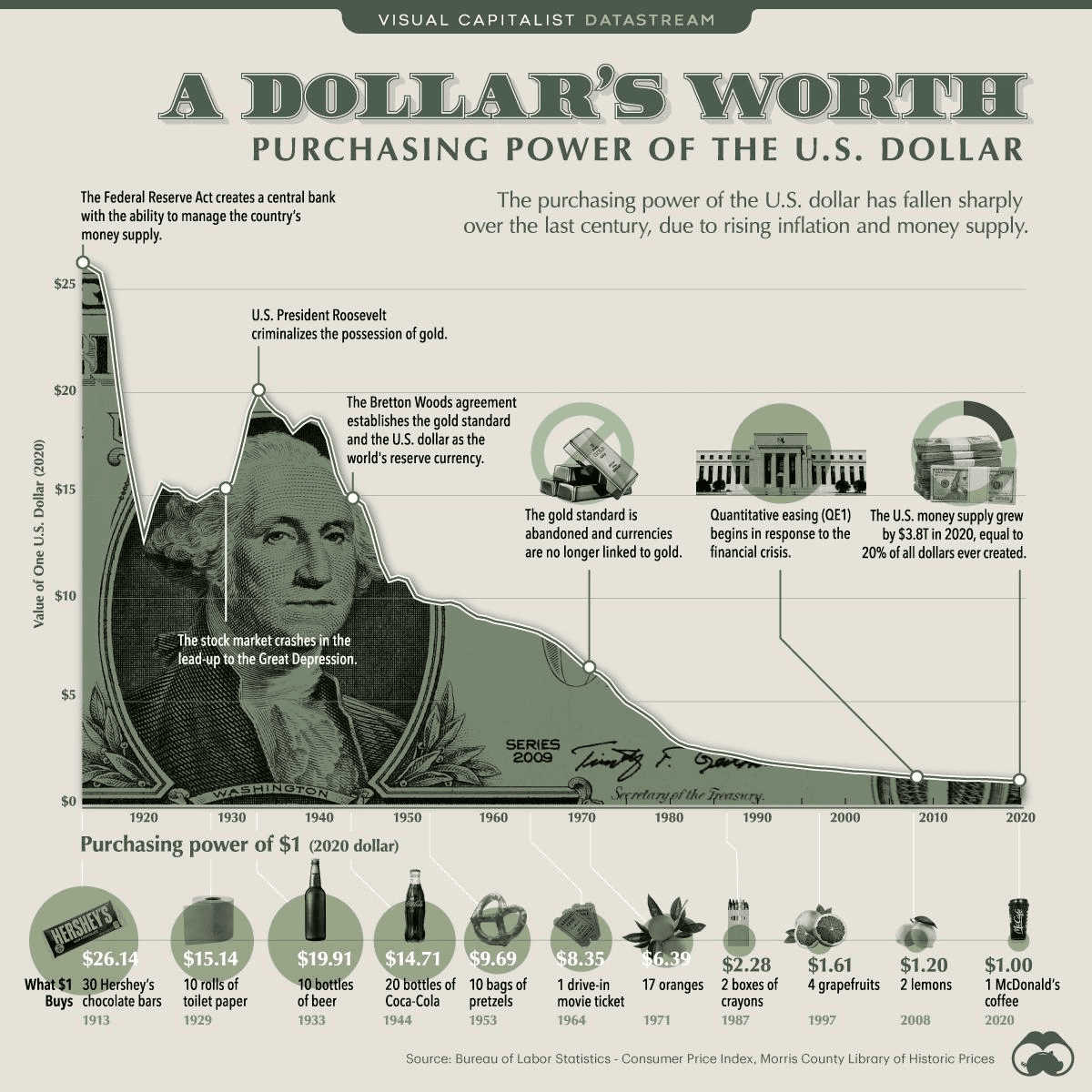
Inflation occurs primarily through monetary expansion and credit creation. “Monetary expansion” is a fancy way to say increase the money supply in the economy. Without getting deep into the mechanics of how that actually takes place, it’s sufficient to say that central banks have a few tools they can use to increase the supply of money and “stimulate” (read: manipulate) the economy. At the risk of oversimplification, consider the subtle implication behind being able to “increase the supply of money.” The money that the average person receives comes at the expense of their real human time and energy. In other words, most people have to work for money; and, as previously discussed, that money received is compensation for their expended life (time and energy). The money that the average person receives is literally imbued with power as it is the result of energy (E) expended over a given period of time (t), P = E/t. The logical question to ask is, where does the power of newly created money come from? If money is “created” and enters the economy with the same purchasing power as all the money already in circulation, then the implication is that the newly "created" money had to be imbued with power just like all the other money people exchanged their time and energy for. The embedding of power is the element whereby the newly created money receives its purchasing power. It’s worth revisiting the law of conservation of energy: energy can neither be created nor destroyed. In other words, only the Lord can create something from nothing. With that said, where did the power of the newly created money come from? Consider a swimming pool full of water. In this example, the size of the pool is a reflection of the size of the money supply and the water inside of the pool represents the energy that the money supply collectively possesses. The expansion of the money supply is like expanding the square footage of the pool while the water (energy) remains constant. In this example, doubling the square footage of the pool is the same as expanding the money supply by 100%. Assuming the pool was full initially, the pool at the end of the expansion would only be 50% full of water across the whole pool. There was no water added in this example because you cannot increase the energy (water in the pool) artificially. There is no added value by creating (printing) money. The answer to the question of how the newly created money receives its power is made clear in the example above. The power that newly created money receives comes at the expense of the money that is already in circulation. The water (monetary energy) that was already in the pool was diluted and spread across both the money that was already in circulation and the newly created money. The water is illustrative of the collective time and energy of all the humans who chose to work and convert their life energy into monetary energy. In some sense, that pool of water might be considered the very lives of the people who store their lifeblood in the pool. The implication is that the expansion of the money supply came at the dilution of real human life.
Labor Then; Labor Now
Circling back to the story of the Israelite Exodus, Pharaoh makes it clear from the beginning that his primary motivation for not permitting the Israelites to leave is the continued extraction of Israelite labor:
But the king of Egypt said, “Moses and Aaron, why are you taking the people away from their labor? Get back to your work!” Then Pharaoh said, “Look, the people of the land are now numerous, and you are stopping them from working.”
To reiterate a point already made, the essence of the “exchange” described above is that of the Israelites having their personal time and energy (manual labor) taken from them and transformed into bricks that are then used to build things for Pharaoh. Pharaoh was the end recipient of all the time and energy he extorted from the bodies of the Israelite people. By the same token, central banks receive the same benefit through increasing the money supply. When money is created, it receives its power by siphoning a little bit of power from every other unit of currency that was already in circulation. On a first principles basis, there’s no difference between the loss of time and energy that the Israelites experienced in their enslaved existence and the loss of time and energy that the average person experiences today via inflation. The central banks are equitable to Pharaoh in that once the time and energy has been stolen from the holders of the currency, the newly created money is at the central bank’s disposal for distribution. That power to steal human time and energy and then reallocate it onto their own purposes is the exact same power that Pharaoh wielded in the construction of his personal store cities. Though not current to date, the chart below is the empirical confirmation of the reality described in the previous paragraph. From 1948 to 1971, the chart depicts a tight correlation between what workers in the United States collectively produced and the compensation they received in exchange for their time and energy (labor). There was a decisive inflection point around 1971 where that correlation was broken and productivity gains (an increase in production) permanently decoupled from the compensation that the typical working individual received. From 1971 onward, hourly compensation has remained flat (unchanged) while production has continued its trend up and to the right. The data is telling the reader that there was a decisive turning point after which the typical worker in the United States no longer received compensation commensurate with their economic output. The specificity of the year 1971 as the determined inflection point is intentional, as that was the year the United States defaulted on its global monetary obligations by depegging the dollar from a gold standard. Before then, theoretically, a central bank could only print as much currency as it had enough gold in reserve to justify. After the gold standard was dropped there was nothing left to constrain the creation of new money by central banks.
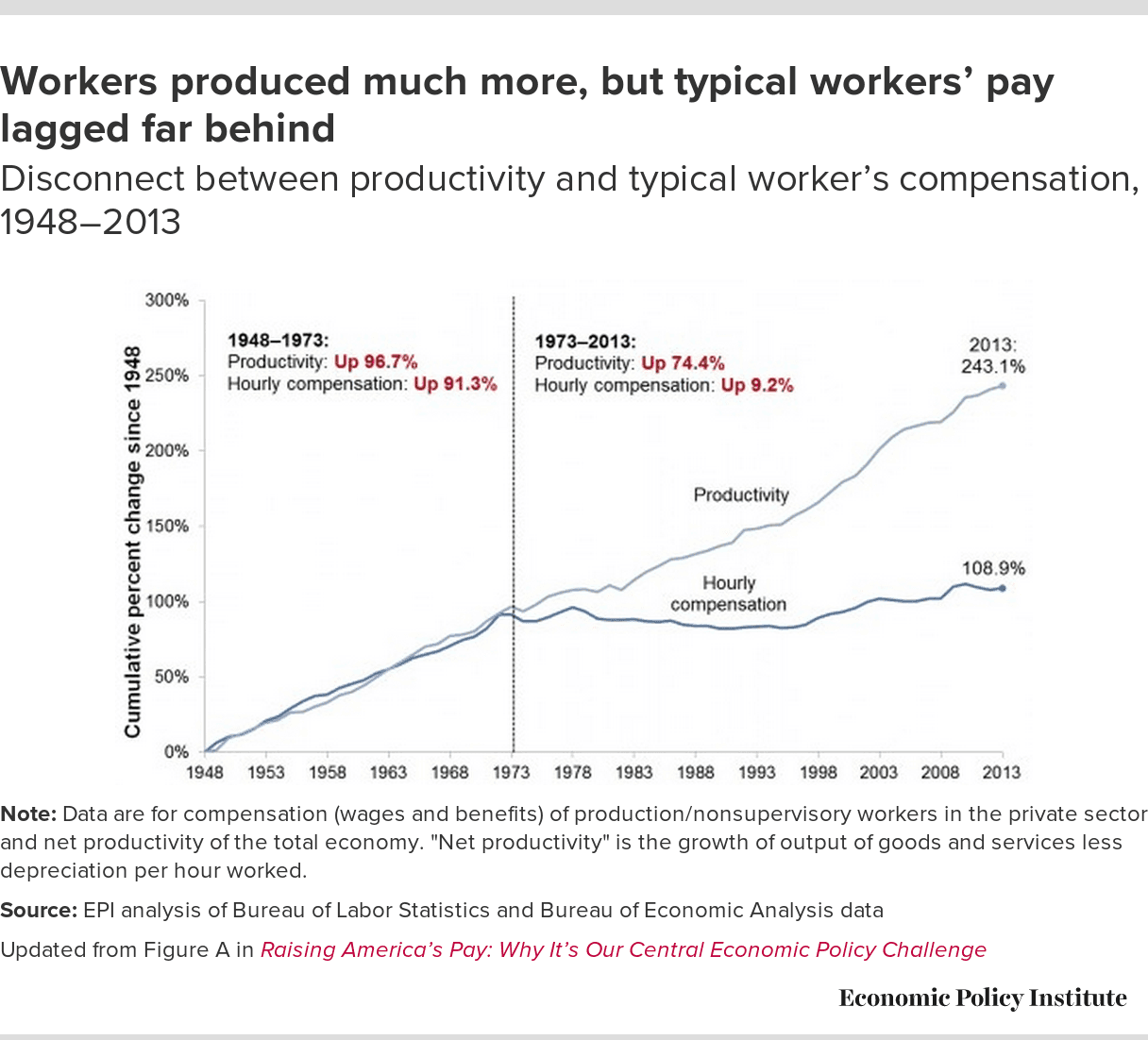
To be intellectually honest, central banks don’t have complete control over the distribution of newly created money. Central banks typically “buy” government issued debt with newly created money, and governments then oversee the distribution of the money, i.e. Fiscal Policy (think: money spending). The central banks pursue economic goals through the creation and removal of money, i.e. monetary policy (think: money creation). The mechanics of how newly created money is actually “printed” and then spent into the economy is intentionally difficult to understand by design. A quote from the late Henry Ford describes the reality: “It is well enough that people of the nation do not understand our banking and monetary system, for if they did, I believe there would be a revolution before tomorrow morning.” The author’s intent is not to be overly simplistic in unpacking the proposed issue at hand, but a concerted effort has been made to synthesize these difficult to understand concepts into something anyone might be able to read and understand without prior knowledge of the subject matter discussed. The inflationary parallel in the Exodus story emerges immediately after Moses and Aaron initially bring their request to Pharaoh for the release of the Israelites. The Pharaoh responds by making the work requirements more strenuous for the Israelites while requiring that the same amount of work be performed:
Then the slave drivers and the overseers went out and said to the people, “This is what Pharaoh says: ‘I will not give you any more straw. Go and get your own straw wherever you can find it, but your work will not be reduced at all.’” So the people scattered all over Egypt to gather stubble to use for straw. The slave drivers kept pressing them, saying, “Complete the work required of you for each day, just as when you had straw.” And Pharaoh’s slave drivers beat the Israelite overseers they had appointed, demanding, “Why haven’t you met your quota of bricks yesterday or today, as before?”
Pharaoh intentionally made the Israelites less productive by refusing to provide them with the straw they were receiving prior to his executive order, but he did not reduce the daily quota of bricks. In that moment, a gap was created between the required quota and what the Israelites were able to produce without having the straw supplied, and the Pharaoh offered a solution concerning how that gap will be filled: “Go and get your own straw wherever you can find it.” In other words, the gap will need to be filled with even more labor (read: more time and energy) from the Israelites. They will need to expend even more of their lives in order to make ends meet. Intentionally reducing productivity while maintaining the quota is the same as reducing purchasing power and assuming someone will be able to maintain their standard of living. The gap between the Israelites unchanging quota (demands/cost of life) and reduced productivity is filled with the very life of the Israelites (aka. they made ends meet by expending more of their time and energy via working longer and more laborious hours). In the same sense, the gap between the unchanging quota today (demands/cost of life) and the reduction in purchasing power of the underlying state currency (the thing used to cover the cost) is filled with the very life of modern citizens (aka. they make ends meet by expending more time and energy than they had been previously via working longer and more laborious hours). The situation that victims of inflationary theft find themselves in today is arguably worse than that of the Israelites in Egypt. As previously detailed: inflation is defined as a general increase in prices and fall in the purchasing value of money. Inflation results in both the loss of purchasing power (loss of life) and a general increase in prices (increased cost of living/cost of life). That is to say, at the same time that money is losing purchasing power, everything around the user of that money is increasing in price. The Israelite equivalent would be a situation where the Israelites experience the productivity loss requiring them to expend more time and energy while the Pharaoh increases the required daily quota. In that situation, the Israelites would experience both a greater loss of time and energy in addition to an increase in quota (demands/cost of life).
Attention
The second order effect of enslavement (the theft of human time and energy) is the loss of the slaves’ ability to pay attention:
That same day Pharaoh gave this order to the slave drivers and overseers in charge of the people: “You are no longer to supply the people with straw for making bricks; let them go and gather their own straw. But require them to make the same number of bricks as before; don’t reduce the quota. They are lazy; that is why they are crying out, ‘Let us go and sacrifice to our God.’ Make the work harder for the people so that they keep working and pay no attention to lies.”
The “lies” that Pharaoh was referring to in the preceding verse was in reference to the message of freedom that God gave to Moses and Aaron to deliver to the Israelites. It’s worth noting that what a tyrant calls “lies” is typically double-speak for what is in all actuality the truth of the matter. The insidious reality at work here is that oppressors can extract so much time and energy (life) from their slaves that the slaves have no time or energy left over at the end of the day to pay attention. To paraphrase from a previous section, “paying” attention implies that attention costs something, and the fundamental cost incurred while being attentive is time and energy. Being attentive requires expending time and energy to be present in a particular setting, listen, think, dream, ideate, and communicate honestly with yourself, others, and with God. If the Israelites were slaves facing the increased theft of their time and energy via their increased workload, when were they supposed to have time to pay attention to anything, let alone the truth? The same question is rightly superimposed upon the modern day worker. If a worker today is having to expend more and more time and energy just to make ends meet due to the predatory effects of inflation, when are they supposed to find time to pay attention? The felt reality of having to work harder and longer hours just to maintain the same standard of living is likely something the reader can personally identify with to some degree. To speak plainly, the increased cost of living contrasted against the falling purchasing power of the underlying currency in which people have infused their very lives is a gap that everyone has to fill one way or another. The options are slim: work harder or cut spending. In reality, there are only so many hours in a day to work, and people can only cut so much until there's nothing left to cut.
It Can’t Be That Bad
A common objection to drawing a parallel between the condition of the Israelites enslaved existence in Egypt to the condition of, lets say, a modern day blue collar worker living in the United States might be that the loss of time and energy is nowhere near comparable between the two. An objective presentation of the data will leave the reader free to draw their own conclusions. The intent of this work is not to be overly technical and nuanced as it pertains to the metrics, mechanics, and idiosyncrasies of the modern day monetary system, but rather provide just enough of a high-level overview for the reader to be able to make sense of the systemic monetary (read: life) oppression that is intentionally shrouded in mystery. With that said, the data presented in this work is an attempt to most appropriately synthesize multiple data points from several sources into a digestible form. The data that is commonly referenced when it concerns the measure (or rate) of inflation is called the Consumer Price Index (CPI). Though this index is utterly flawed by any metric, this is the standard and, for the sake of brevity and simplicity, the following assessments in this section will reference the CPI without qualification. If people ask what the rate of inflation is or if someone is making a news announcement in reference to rising or falling inflation, this is the number referenced. The chart below depicts how the information is typically presented:
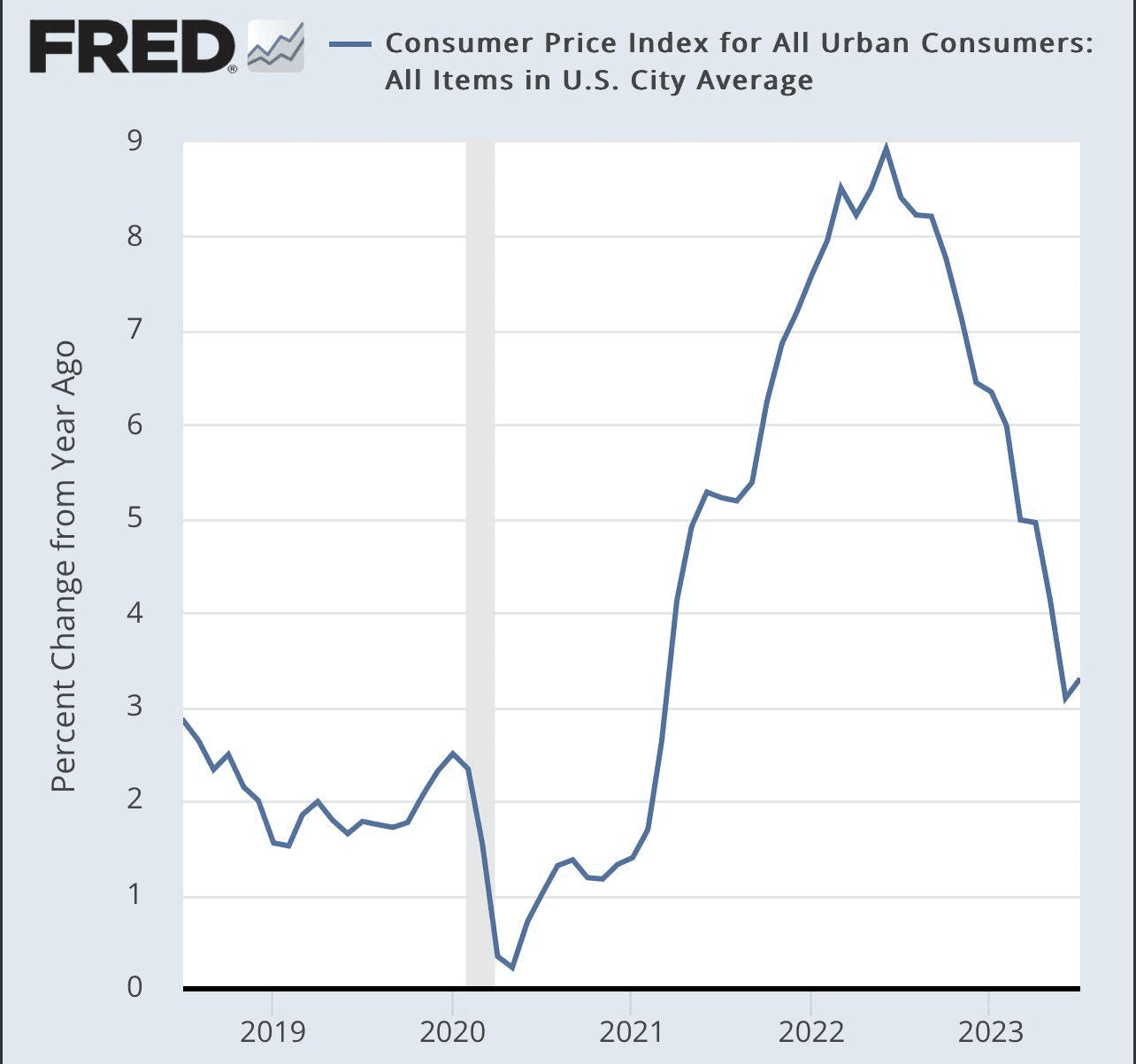
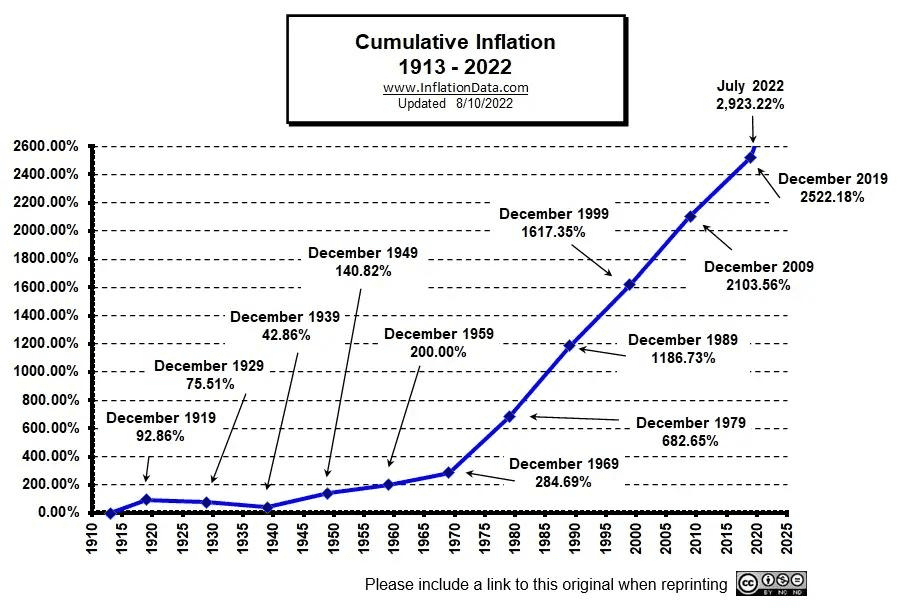
At the time of writing, US Consumer Price Index YoY is at 3.67%, compared to 3.18% last month. Without knowing what the data is saying, 3.67% might seem inconsequential, but it’s important to recognize that this is a year over year (YoY) metric. The US Inflation Rate is the percentage which a chosen basket of goods and services purchased in the US increases in price over a year. Meaning, at the time of writing, the goods and services in the measured basket of goods are, on average, 3.67% more expensive than they were 12 months ago. That number may still appear small, but what is not taken into account here is the compounding effect of inflation over time. Compounding interest is something people reading this are likely to be more familiar with. Compound interest is calculated based on the principal amount initially invested plus the accumulated interest of previous periods, and thus can be regarded as “interest you earn on interest.” The same idea works in the opposite direction for compounding inflation. The YoY rate of inflation is currently 3.67%, but the chart above isn’t telling the whole story. There is 3.67% more inflation today than there was a year ago, but there was inflation last year too, and the year before that, and the year before that, and so on. The idea is that inflation is compounding exponentially, meaning that it builds on itself over time at an increasingly rapid rate. The central bank targeting a 2% inflation rate might appear unassuming, but targeting a 2% rate of inflation every year for 50 years has significant compounding effects. Inflation is more accurately presented over a longer time horizon to provide the proper perspective:
Bringing It Home
The synopsis of the last few sections: inflation is the theft of real human life, and that theft has been far from inconsequential over time. To drive the point home, one only needs to consider the last few years of money supply increase. The chart below is a measure of the M2 money supply. M0, M1, M2 and M3 are measurements of the United States money supply, known as the money aggregates. Again, nothing is straightforward with regards to the current financial system, and that most pointedly applies when trying to determine exactly how much money (US dollars) are in the system. Suffice it to say, the M2 money supply is a key indicator for policymakers and economists to monitor the availability of money within the economy, and for that reason it is cited below.
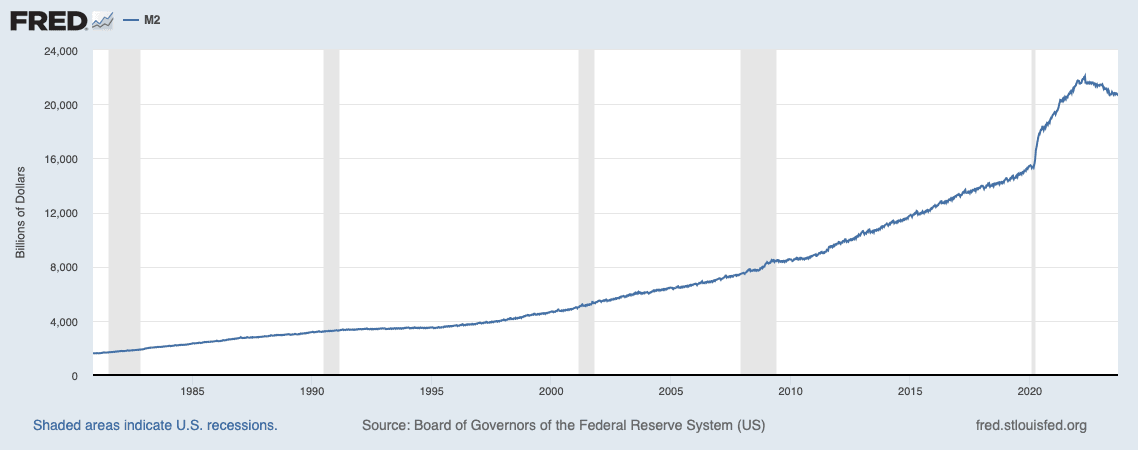
The money supply, according to M2, has grown an average of 7.7% a year since 2008. Monetary policy responses to the 2020 pandemic caused higher-than-average yearly increases in M2. From 2019 to 2020, M2 increased by 19%, followed by an increase of 16% the following year. That means that 35% of all dollars in circulation today were printed in two years, from 2019 to 2021. In those two years alone, everyone holding US dollars was diluted by 35%. To reiterate, their accumulated “life's savings” (intended literally here) was diluted (read: stolen) by 35% of the whole. Personified more tangibly, consider a 35% dilution of a particular group of people, let's say, a congregation of people who attend a particular church. In practice, each individual member will realize 35% less purchasing power in their money (time and energy), and that directly correlates to an increased cost of living over time to the tune of 35%. That increased cost can either be made up by expending more time and energy at work or reducing expenses. The dilution, in practice, is indirect and takes months to play out in its entirety. By the time the inflationary effects have set in for the average household a new status quo has already been established, and very few think much of it. Now imagine a hypothetical scenario where the dilution of the congregation played out immediately and affected as few people as possible while maintaining the rate of dilution. In this scenario, 35% of the congregation would bear all of the dilution while the remaining 65% of the congregation wouldn’t realize any dilution. Assuming a congregation of 100 people, 35% of the congregation, or 35 of 100 people, would realize a 100% loss. This is the immediate loss of all time and energy of the 35 people while the remaining 65 people would not be affected at all. In the end, there would be 65 whole (undiluted) people, and the remaining 35 people would be full time slaves. The alternative conceptualization would be 65 people left whole (undiluted) and the remaining 35 would be no more (liquidated). The hypothetical creative liberty is intended to drive home a point: there is no difference, on a first principles basis, between dilution currently in practice and the hypothetical scenario offered above as it pertains to the real loss of human time and energy. One occurs across the entire congregation over a span of months, whereas the other occurs immediately and affects as few people as necessary while maintaining the dilution rate. If the hypothetical scenario were somehow realized, the pain of dilution (loss of life) would be readily apparent, and it is fair to assume the response of the congregation would be very different from how it responded in the original dilution event. Therein lies a key insight: the nature of the dilution being subtle and ubiquitous makes it very difficult to object to or even become aware of for that matter. The idea harkens to the boiling frog syndrome. The premise is simple: if a frog is suddenly put into a pot of boiling water, it will jump out and save itself from impending death. But, if the frog is put in lukewarm water, with the temperature rising slowly, it will not perceive any danger to itself and will be slowly cooked to death over time. Boiling water is obvious in the same sense that physical enslavement is obvious. What isn’t so obvious is the thing that slowly rises in temperature over time and yet leads to the same result. There’s an argument to be made that the boiling water scenario is preferable, as the nature of boiling water at least provides the frog with clarity regarding its circumstances, namely, “the water is hot”. The frog left in the lukewarm water that slowly rises in temperature over time does not have clarity regarding its circumstances until it’s too late, though the felt reality of the slow death is felt all the way through.
The Lord Sees
Before this work can progress into something that might resemble an “action point,” an important point needs to be made clear. The canonical Exodus story is of the saving power of God enacted against tyrannical oppression that enslaved His people. As previously mentioned, that saving was brought about entirely by the arm of the Lord who delivered His people apart from any Israelite contribution. If the word articulated in this work accomplishes anything, let it be the realization of dignity it provides the reader in being able to, like the Israelites, “groan” and “cry out” to the Lord with clarity regarding their felt systemic oppression.
During that long period, the king of Egypt died. The Israelites groaned in their slavery and cried out, and their cry for help because of their slavery went up to God. God heard their groaning and he remembered his covenant with Abraham, with Isaac and with Jacob. So God looked on the Israelites and was concerned about them.
Though physical enslavement is nothing to be admired, the experience of knowing exactly who is doing the oppressing and how exactly they’re doing it allows those who are being persecuted the dignity of least being able to stand up and look their perpetrators in the face. There is a unique and arguably greater pain reserved for those who also “groan” and “cry out” in their oppression but do so aimlessly and without clarity as though they are feeling their way through the dark. With that said, clarity in crying out to God is not a prerequisite that leads to God’s saving power being released.
And now the cry of the Israelites has reached me, and I have seen the way the Egyptians are oppressing them. Exodus 3:9 (author’s emphasis)
Outside of whether or not those who are being oppressed understand the fundamentals of their oppression, the Lord sees. The idea is that the Lord sees even, and maybe even especially, when those who are being oppressed do not. Though intentionally shrouded in mystery and ambiguity, the Lord is not confused concerning the totalitarian, systemic oppression of the hour.
The Printing Press
The implicit idea behind a “Modern Exodus” story is not only that systemic oppression is present and active today, but that the Lord intends to deliver us from it. Though His saving may not exactly look like being led out by a pillar of cloud and fire, rest assured that He is leading and speaking even now “though man may not perceive it” (Job 33:14). Personal bias, preconceived notions, and certain expectations compete with what might otherwise be revealed and received as revelation by hearts and minds primed for it. It is worth briefly touching on some recent Church history in order to prime the heart and mind for that receptivity.
The 16th century Protestant Reformation was a significant inflection point that had profound social, political, and cultural implications across Europe, contributing to religious diversity and reshaping the religious landscape. An image of Martin Luther posting his ninety-five theses on the door of the castle church in Wittenberg likely comes to mind when initially considering the reformation, but it took much more than one copy of the 95 theses to bring about widespread reformation. The idea is that a single copy of the 95 theses would have been insufficient to spark reformation, but the 95 theses personally held in the hands of each and every individual who had the inclination to listen and receive the message was able to facilitate what we now recognize as the Protestant Reformation. That widespread dissemination of a then counter cultural viewpoint was only made possible through a very specific piece of technology: the printing press.
The printing press, invented by Johannes Gutenberg in the 15th century, revolutionized the way information was shared. In the context of the Protestant Reformation, this invention proved crucial for the mass adoption of a viewpoint that the dominant power at the time, the Catholic Church, stood against. Before the printing press, books were copied by hand; predominantly by the hands of monks in monasteries associated with the Catholic Church. The production of religious texts, classical works, and manuscripts wasn't exclusively controlled by the Church, but it was a major patron and custodian of knowledge prior to the invention of the printing press. With the printing press, Martin Luther's 95 Theses, a document challenging the practices of the Catholic Church, was able to be reproduced and distributed far more efficiently among the public. The printing press essentially democratized information, empowering individuals with access to diverse perspectives and contributing significantly to the Protestant Reformation.
In the 21st century, almost all there is to know is virtually ubiquitous and freely accessible, but there was a time when all information required a custodian. That means that there was a time when knowledge necessitated a gatekeeper in order for it to be maintained and distributed. A gatekeeper, by design, was the leading edge technology of the era when it came to the spreading of knowledge, but it came with many limitations and vulnerabilities. There were limitations to how much literature could be produced by hand, and there were many systemic vulnerabilities regarding the integrity of the knowledge as the gatekeepers quickly realized the intrinsic power in having a monopoly on information. The maintenance and distribution of knowledge is now taken for granted in a world where all knowledge is “maintained” online and is no longer distributed but rather freely accessed as desired.
To drive the point home: no printing press means no Protestant Reformation. Said differently, the very essence of Christianity would not be what it is today if it were not for the invention of the printing press. The magnitude of significance that can be attributed to this single technological innovation cannot be overstated. In the era preceding the Protestant Reformation, the very Word of God had been captured by the Catholic Church due to the “centralized” nature of scriptural doctrine at the time. The physical church had a monopoly on what there was to know about the Word of God and therefore held a significant amount of power as the result of that privilege. The layperson's ability to receive the Word for themselves served as a revelation to them, in some real sense. Despite there being no “new divine revelation”, the personal receiving of The Word for themselves made it revelation to them. The foundational and formative underpinning of the Church today is the direct result of the Lord unleashing the revelation of His Word on the rails of human innovation.
Idols and Arks
To be clear, The Word is and always has been sufficient in and of itself to accomplish everything the Lord intended for it, but the integrity of The Word is not what is being discussed here. The purity of The Word is completely separate from the dissemination or implementation of it. To use an Exodus analogy, the gold (read: pure substance) that the Israelites plundered from the Egyptians on their way out of Egypt was used to make both the ark of the covenant (Exodus 25:11-13) and the golden calf (Exodus 32:4). The substance can be set apart, but if you make an idol out of it then it becomes a detriment to both the craftsman and those who rely upon it. If what is pure and free on its own accord is taken, curated, and disseminated by a gatekeeper (e.g. Aaron) then the outcome is an idol by definition.
The distinct difference between the formation of the ark and the casting of the golden calf is the manner in which the gold is procured from the Israelites. The gold used for the ark was freely given as an offering to the Lord by hearts prompted to give (Exodus 25:2), but the gold used for the golden calf was taken from the Israelites as a requirement (Exodus 32:2). In order for the sacrifice to become an ark it has to be offered freely and willingly. Any “sacrifice” that is coerced is not actually a sacrifice, but rather something stolen. Anything created from material acquired dishonestly, regardless of intent, is destined to become an idol that perpetuates its own existence. An idol comes with an initial cost, but those who worship it will come to find that the cost is never-ending and is exacted until there is nothing left to give.
The reference to gold above allows for a clear parallel to money. All “gold” (money) in someone's life has the potential to become an idol or an ark that points to something, and that something is that which is being worshiped. The “gold” (money) becomes an idol if it is transformed into a false god, a place in which faith is deposited outside of God (e.g. golden calf). The “gold” (money) becomes an ark if it is used to uphold that which is of the highest order (e.g. ark of the covenant). “Gold” (money) has the potential to become either an ark or an idol; it boils down to how the gold (money) is used.
Physical gold serves as a good example of how money is our very life because there’s a sense in which gold is what it is. Gold, on an elemental level, is known as a noble metal which means it’s extremely resistant to corrosion or tarnishing. In fact, it is the most noble of all metals. The idea is that it is what it is and will remain that way until acted upon; it’s pure and untarnishable potential. It simply is what it is, therefore the most significant thing about it is what is done with it. Gold may be perceived as “neutral” here and therefore profane, but just because a substance is neutral doesn’t mean it’s not sacred. Things can be sacred even if they are purely potential; a newborn baby is a good example of this. A newborn has neither created arks nor cast idols. In the moment of their birth, they just are (aka. potential), yet anyone who has held a newborn baby will recollect the holiness of the experience. Life in a neutral position can be sacred, therefore money, which is our very life, can also be sacred in its neutral position. We all exist with potential; the potential to do this or do that; the potential to expend our lives making idols or making arks, and it is precisely that neutral position of potentiality that money is the embodiment of.
Connecting The Dots
If our life is sacred then our money should be viewed in the same light. As reiterated consistently, money is most appropriately considered amalgamated human time and energy, and thus the encapsulation of our very lives. The implication is that the users of the money should be just as concerned with the preservation of the money as they are with the preservation of their very lives. The preserving of life referenced here is different from “preserving your life” in Luke 17:33: “Whoever seeks to preserve his life will lose it, but whoever loses it will save it”. Preserving your life in Egypt looks like being set free from tyranny, whereas preserving your life on the other side of the Red Sea looks like “losing it”. Where the Israelites are as per the order of events in the Exodus story matters when considering their relationship to the Lord and the world around them. In order to “lose” something you have to have it in your possession in the first place. If you don’t have the rightful possession of your own life or you slowly lose more and more of your life over time, then as you attempt to “lose your life” (for the sake of Christ) you’ll find that you have less and less (or nothing) left to give as time progresses.
If an entire nation, or global population for that matter, were subjected to the tyrannical siphoning of their very life via the inflation of their money (life), then it would be appropriate to consider that nation or global population as living in the midst of a tyranny that’s slowly consuming them. Therefore, as per the order of events outlined in the Exodus story, their current condition would place them in the beginning as slaves in Egypt. It would be crucial to make that precise distinction as per their placement in the order of events so that the people being oppressed would be able to make sense of their current circumstances and thus conduct themselves appropriately in the sight of God. Unfortunately, though the above scenario was presented as hypothetical, it is, to varying degrees based on geographic location and jurisdiction, precisely where we all stand at this moment. We all live “in Egypt” as those who experience daily, and certainly cumulatively over time, the real effects of the theft of our very lives.
If this presupposition holds true, then “crossing the Red Sea" would look like moving from a place where the collective life of the people (the money) is no longer stolen via inflation into a “land” where the value (power) of the money is preserved over time. When considering global economic (i.e. household management) realities, references to “crossing the Red Sea” and “moving into a land” are all abstractions reflecting a reality that is non-geographic in nature. If inflation is the fundamental source of oppression, then it stands to reason that freedom from tyranny lies on “the other side” of the current monetary system we currently live in. Inflation is a feature of the current global monetary system, not a bug. Therefore, in order to rid the world of inflationary tyranny, the entire monetary system as we know it today will have to be dispensed with. What is being proposed concerning a potential “Modern Exodus” is the “moving into” a new system in which the soundness of the new money is reflected in the soundness of the system on a technical and ethical level.
Plundering the Egyptians
In a non-trivial sense, the necessity of completely dispensing with the tyrannical order is intuitive when superimposed on the Exodus story. The Israelites moved from a jurisdiction predicated on slavery to a completely new jurisdiction where they were free. Granted, they moved from Egypt into the desert where they had to then work out their new found “freedom” for 40 years until they were ready to move into the promised land. The Israelites moved from slavery in Egypt to wandering in the desert. Similarly, dispensing with tyranny today will not directly lead into the “promised land” tomorrow. This work specifically focuses on freedom from tyranny because that’s where we currently stand as per the order of events. Many more pages could be written comparing and contrasting the rest of the Exodus story with an endless set of potential futures, but if at first we don’t properly orient ourselves in the story then we can’t take the steps necessary to “walk across the Red Sea”. We must first concern ourselves with freedom from tyranny so that we might thereafter consider what we have the freedom to do. Freedom from precedes freedom to.
It might be helpful to consider what part of the Israelite “transition of jurisdiction” looked like in the canonical Exodus story in order to better understand how something similar could occur in a “Modern Exodus”.
And I will make the Egyptians favorably disposed toward this people, so that when you leave you will not go empty-handed. Every woman is to ask her neighbor and any woman living in her house for articles of silver and gold and for clothing, which you will put on your sons and daughters. And so you will plunder the Egyptians. Exodus 3:21-22
There is certainly an aspect of the Exodus that is unavoidably tumultuous in nature, and that is clearly embodied in the plagues as well as the climactic, final destruction of Pharaoh and his army in the Red Sea. With that said, in the scripture offered above, there’s a sense in which there’s an implicit acknowledgment, and thus an agreement of sorts, by the people of Egypt that the order of all things is changing. Yes, the text makes it clear that the Lord “made the Egyptians” favorably disposed towards the Israelites, but just because the Lord did it doesn’t take away from the fact that it happened. It’s important to recognize that the Pharaoh and his army that pursue the Israelites into the Red Sea take center stage in the final scene, but they actually represent the minority Egyptian view concerning the Israelites at this point. Pharaoh relents and allows the Israelites to leave following the final plague of the firstborn, but it’s the Egyptian people at large who “urge them to hurry and leave the country” (Exodus 12:31-33).
Historically speaking, there is often a clearly delineated structure within a tyranny that leads from “the Pharaoh” down to his “officials”, his “army”, and then finally the “people of Egypt” who are, in a sense, outside of the enforcing arm of the tyrannical structure. This is by no means an attempt to excuse the Egyptian people; it’s simply worth noting that the population at large is often at odds with their own governing authorities. The reader might consider whether or not the same might be said of their own governing authorities at the moment. Admittedly, there’s a lot going on in the text at this point in time, and the scripture offered above outlines only a small portion of the story unfolding. This idea isn’t intended to supersede any overarching narrative, but rather provide additional perspective to the intricate nuance of how the Israelites actually left Egypt.
The Israelites not leaving empty handed harkens back to the law of conservation of energy, namely that energy cannot be created or destroyed, although it can be changed from one form to another. The “plundering of the Egyptians” was literally a transfer of energy from one regime to another that was actively facilitated by the Lord, as He Himself made the Egyptians favorably disposed towards the Israelites. The transfer having been conducted in gold was no coincidence. To reiterate, gold is a representation of “neutral”, pure and untarnishable potential, which makes sense considering that an exchange between two competing value systems can only take place in a “neutral” asset. The gold is indicative of pure energy; in a sense, God is literally empowering the Israelites with the potential to be. What they will become exactly is dependent on how they conduct themselves with that gold on the other side of the Red Sea, but what’s important to note here is that the Lord has not rescued the Israelites and left them powerless or “empty-handed”. He set them free and energized them with the potential “to be” on the other side. What they decide to do with that potential (gold), whether it be the construction of an ark or the casting of an idol, is entirely up to them.
With the Lord serving as the One who facilitated the transfer of gold into the hands of the Israelites, it’s appropriate to consider the gold itself as a gift from God. That’s an important point to make in the midst of a modern Christian experience that has spiritualized away much of the physicality behind relationship with the Lord and, to a degree, even relationship with the physical world. The Lord rescued the Israelites from Egypt and made it a point on their way out to imbue them with physical tools they would soon need (gold) to properly respond to the call of God unto the establishment of a covenant. Establishing the covenant came not only with the revelation of the ten commandments that would serve as the principle foundation of their relationship with the Lord, but also a physical foundation embodied in a set of physical instructions concerning the construction of the tabernacle so that the Lord might actually dwell among them. The Lord was jealous to be with His people and therefore had the Israelites make the appropriate physical preparations to facilitate that union on earth.
The construction of the tabernacle and its furnishings required the use of several physical materials, among which gold arose preeminently as that which would be used in the construction of the most sacred furnishing in the tabernacle, the ark of the covenant. It is the use of the physical to encapsulate the divine for the explicit intent of union between the Lord and the Israelites that is the real story, a story of divine innovation. Despite its modern perception, “innovation” is fundamentally the practical implementation of an idea that results in the introduction of something new. Therefore, referring to the physical union of the Lord with His people on the earth as an “innovation” is more than apt at this point in the biblical narrative. The specific use of the word “innovation” is intended to trigger the modern reader by what is likely perceived as the inappropriate conflating of what might be considered intrinsically spiritual with that which is likely considered explicitly physical. Innovation is typically associated with human ingenuity as it pertains to development and implementation of new technologies and is generally associated with value creation through the introduction of new goods or services or improvement in offering goods or services. Referring to a prior example, the printing press fits nicely into this rigid and explicitly physical definition of what is considered “innovative” in the world. And therein lies a potential problem for the spiritual purist, namely the cognitive dissonance required to believe that the printing press was a purely human technological innovation while simultaneously holding that the formative underpinning of the Church as we experience it today is the direct result of the Lord unleashing the revelation of His Word on the rails of that human innovation. The point is that when it comes to technological innovation it isn’t always obvious whether or not the idea originated solely from the carnal. The notion echoes the mystery of "Christ in you, the hope of glory”, the implicit idea being that we should be hesitant to draw definitive lines between the secular and the sacred.
The printing press is a continuation of the theme of neutrality expressed throughout this work. The printing press proved extremely powerful for the dissemination of information, but it is fundamentally “neutral” in that it can be used for the printing of both truth and falsehood. To combine this example with the prior example of gold: the printing press can either print arks (propagate fundamental truth) or print golden calves (metastasize falsehood). Just as with the use of gold in the canonical Exodus story or the use of money in our modern lives, the creation of an ark or a golden calf is fundamentally the reflection of a decision. That decision originates from a condition in the human heart, which is in some real sense entirely disconnected from the technology (gold or money) itself.
Providence
The canonical Exodus story leads with the recurring and overwhelming display of providence that then leads to the receiving of the gold on their way out of Egypt. The saving, providential power of God is undeniable in how it manifested itself in the display of decisive and mighty plagues. Moreover, the Bible makes it clear that the display of the first three plagues affected the Israelites as well as the Egyptians. The Israelites were subjected to the first three plagues but shielded from the rest; which communicates that there’s something inescapable about providence and reckoning even for the oppressed. There’s a measure of inescapable providence simply due to proximity, namely proximity to the tyrannical oppressors. The overarching principle is something like: though His people are oppressed, the Lord has them experience an appropriate measure of the judgment collectively, alongside their oppressors, to bring about a shared experiential solidification of conviction in the Lord’s seriousness concerning His judgements. He apportions the appropriate amount of universal judgment commensurate with what His people need as an inoculation of sorts, but He shields them from the brunt of it. By carefully “injecting” a measure of the consequences (the plagues) of the evil of the Egyptians into His people, He hopes to inoculate them against the evil of tyranny; “In wrath (He) remembers mercy.” The mysterious nature of providence alone combined with peculiarities in how it is experienced personally leaves room for its entrance into the story of the Modern Exodus. As per the Exodus story, the providential hand of God slowly destabilized the order of systemic oppression in Egypt. With consensus concerning the modern felt reality being something akin to an overall societal destabilization, it’s worth considering whether or not a portion of that destabilization might be rightly attributed to the providential hand of God. The Lord has the ability to exercise discretion and selectivity when exercising His sovereign judgment, and therefore could very well be in the middle of exercising His judgment even now in opposition to the tyrannical oppression of the hour. The significance in proposing that the unraveling might be the Lord’s doing is that it further supports the notion that we may very well be in the middle of a Modern Exodus. This isn’t intended to write off the direct consequences of sin or the principle of sowing and reaping, it is simply to add an additional avenue of possibility concerning the unraveling we’re experiencing. The reality of things is likely a differentiated mixture of a multiplicity of contributing factors, but chief among them may very well be His hand in direct response to tyranny.
Decisions
As deciphered from the text, the story of the Exodus is one where the Israelites found themselves enslaved and powerless, consequently needing the saving power of God to deliver them apart from even the smallest thing they might be able to obey and thus “contribute.” With that said, there are two things that the Israelites do in Egypt during the Exodus that have a significant impact on their rescuing. The first was the decision of whether or not to put the blood of the lamb on their doorposts in order to survive the final plague, and the second was the decision of whether or not to ask the Egyptians for gold as they made their way out of Egypt. Both decisions would have had significant consequences had the Israelites made the wrong decision.
In a tyranny, you have to differentiate yourself lest you intentionally or unintentionally become consumed by the nature of that system, the nature of the “gods of Egypt” (Exodus 12:12). There’s a sense in which you can’t make that distinction on your own accord. That’s why you can’t put your own blood on the doorpost, it requires something higher and outside of yourself to serve as a sacrifice sufficient to cover that part of you that has been infected by “the gods of Egypt”. The message behind the blood on the doorpost in Exodus is: “make the proper sacrifice or the impropriety of your own life will have to stand on its own accord, and thus be consumed”. The blood on the doorpost is put there in faith, not necessarily out of any real understanding of the sufficiency of the sacrifice being made. In the act of placing the blood on the doorposts, the Israelites communicated that they were set apart because they had chosen to willingly subjugate themselves to a sacrifice that was higher than themselves. The fundamental Egyptian principle at the time was predicated on a hierarchy that placed Pharaoh as the ultimate authority, whereas the Israelites made a decision to willingly come under the authority of the Lord. The blood on the doorposts was step one in the final process of the Israelites making their way out of Egypt, step two was deciding to ask for the Egyptian gold as they were leaving Egypt. It’s easy to write off the significance of step two, as the consequences of getting step one wrong seem to significantly overshadow the implications behind simply leaving Egypt “empty-handed”. There’s a decisive finality in the last plague that’s embodied in the literal death of the firstborn across all of Egypt. If you get step one wrong, you die, but if you get step two wrong then you soon find yourself “in the desert” without the materials necessary to participate in covenantal union with the Lord. In order to “move into the desert” and be successful you have to first receive the gold, and you receive the gold by having the humility to ask for it on your way out of the tyranny. The key is being humble enough to ask for the gold on the way out. You don’t want to be in a position where the Lord asks you to build an ark, but you don’t have the gold to do so.
Building A Dwelling Place
Today, the Lord’s presence is not contained in arks or tabernacles, but rather “dwelling in our hearts through faith” (Ephesians 3:16). Though the “building material” of that which hosts the Lord’s presence has changed from gold and acacia wood to flesh and bone, the physical nature of His habitation remains the same. If there is anything sacred, it's the place where the Lord resides. This reality was so tangible in the old testament that you would immediately be struck down for so much as laying a hand on the ark of the covenant. In the same way that tampering with the arc of the covenant came with consequences, so too does manipulating the modern rendition of the Lord’s encampment, the human body (1 Corinthians 6:19). If that holds true, then it’s worth considering what might be considered a “sin against the body.” Money is the essence of physical life in that it is fundamentally human time and energy. With that said, the manipulation or dilution of the money is akin to tampering with the ark, there is no more egregious sin.
Similar to how the gold served as the material used to build the ark of the covenant, money serves as that same “physical material” today with which we have the opportunity to build a modern dwelling place for the Lord. Unbeknownst to the Israelites, they received the gold as something of a reconciliation for all the time and energy lost while enslaved in Egypt. They cast both an ark and an idol out of that same gold, and that’s precisely what made the magnitude of the subsequent glory and sin respectively so great; they created those things out of their very being. They gave themselves over to each of those things in the most intimate way possible by using the gold that was fundamentally the personification of their very lives. Moses understood this idea. That’s why he had the Israelites literally drink (internalize) the gold of the golden calf:
When Moses approached the camp and saw the calf and the dancing, his anger burned and he threw the tablets out of his hands, breaking them to pieces at the foot of the mountain. And he took the calf the people had made and burned it in the fire; then he ground it to powder, scattered it on the water and made the Israelites drink it.
Moses made them drink the gold because he wanted to drive the point home: the gold was literally the personification of their very life. The forced drinking of the gold was actually the mercy of Moses offering the Israelites a second chance. As the Lord’s prophet, “in wrath (he) remembers mercy”. Drinking the gold served as a physical reminder that the gold was a derivative (in the financial sense of the word) of their very life, and thus should be considered as sacred as life itself. They internalized the gold with the implication that it would be “digested” and then come out imbued with life anew as though it were being derived from their bodies for the first time, a second chance. The labor of digestion producing the second rendering is illustrative of the initial rendering of the gold that came through work/labor (the expenditure of time and energy). There is no clearer symbolic representation of money as your life than this.
Receiving money on the way out of the Modern Exodus tyranny is the receiving back of lifeblood (energy) required to “build an ark” on the other side of the “Red Sea”. Among all the value in Egypt, gold was the only seemingly Egyptian relic that made it out of Egypt, but that isn’t exactly correct. The only thing that made it out of Egypt was the Israelites themselves (past, present, and future). It’s the combination of their past (past life, the gold) with their present life (the Exodus) that allows them to realize their future life (the Promised Land). The “Egyptian gold” received in Exodus 12 isn’t Egyptian at all. When asked for, in a spirit of humility and received in faith, the gold becomes the realization of life lost in the hands of the Israelites. By asking for it on the way out, there’s a sense in which an oppressed person receives their life back in a spirit of both humility and dignity.
Bitcoin
If money in the Modern Exodus is playing the part of the gold in the canonical Exodus story, then the substance of that money is of the utmost importance. As previously established, in order to rid the world of inflationary tyranny (the current oppressive system), the entire monetary system as we know it will have to be dispensed with. Dispensing with the monetary system implies getting rid of the money used in the previous system, as it was the very thing that facilitated the oppression. Speaking to the substance of the money is calling into question the mechanical, technological fundamentals that empower and facilitate the money creation and maintenance of the money.
Similar to how the Church served as a major patron and custodian of knowledge prior to the invention of the printing press, central banks and federal authorities now stand in the same position as the creators and maintainers (“gatekeepers”) of money (life). The monopoly used to be on information, but now the monopoly is on all value (or all life itself). Prior to the invention of the printing press, the Christian congregation was “enslaved” to the will of the Church. That reality was soon realized economically through the Church leveraging its monopoly on information to establish the sale of indulgences and other practices which encouraged financial contributions, reinforcing the Church’s economic power. It was through a roundabout means of information distribution (aka. the printing press) that the tyrannical power of the Church was able to be checked. To witness a similar check on tyrannical power today, there would need to be the invention of money that would enable a similar roundabout means of distribution and maintenance with regards to value (or life). No one can have a monopoly on information in a world with the internet (the successor to the printing press). Similarly, no one would be able to have a monopoly on money in a world with a technologically superior iteration of money that prevented centralized creation and maintenance.
Insofar as technology permits, Bitcoin is the latest iteration of money that most accurately reflects the principle of decentralized creation and maintenance. The truly decentralized nature of Bitcoin is what sets it apart as that which has the potential to stand up a new economic system predicated on total freedom. Realizing complete and unhindered freedom post-Exodus leads to the creation of a golden calf just as quickly as it leads to the creation of an ark, but that is the price to pay if you want to build something fundamentally predicated on freedom. Realizing freedom is one thing; establishing a covenant (establishing an order) in the midst of that unabated freedom is something else entirely. If you want to build out from a place of freedom, then you have to use a neutral material endowed with supreme power, and that reality of neutral yet exceptional is exactly what is being symbolized in the gold received by the Israelites because it is the essence of Israelite life itself.
In the canonical Exodus story, the gold served as the medium with which the Israelites were able to physically build out their union with the Lord on the earth. In the Modern Exodus story, Bitcoin is the medium with which everyone alive today has the opportunity to render as they see fit. “As they see fit” employs an echo of another biblical reference to money: “‘Whose image is this? And whose inscription?’ ‘Caesar’s,’ they replied. Then he said to them, ‘Render to Caesar the things that are Caesar’s, and to God the things that are God’s’” (Matthew 22:20-21). You will naturally pay tribute to the one who’s inscription you see on your money. As the Israelites “saw” (read: superimposed) their own life (or will) “inscribed” on their gold, they naturally built a golden calf with it, but insofar as they are able to “see” the Lord Himself “inscribed" on their gold, they built an ark. What you build with the gold is entirely predicated on how you render it, but that idea only holds true if the gold isn’t inscribed for you. If you deal in gold (money) inscribed for you then you will naturally render onto that predetermined inscription for as long as you deal in that particular gold (money).
Bitcoin is the modern iteration of the “uninscribed gold” that the Israelites received on their way out of Egypt. Though Bitcoin is seemingly predicated on certain ethics and economic principles, at its core it is nothing more than math and code being run on hardware. In a sense, everything else outside of mathematics is subconsciously superimposed onto the code by the user. The math and code are similar to the unique particularities characterized by gold on an elemental level. If gold is the most noble metal, then Bitcoin is the most noble money. To date, it serves as the best iteration of neutral potentiality that ideal money ultimately embodies. This is not a work intended to highlight the technological superiority of Bitcoin. There are plenty of resources at hand for anyone interested in learning about Bitcoin as a technological, mathematical, and cryptographic innovation, but that’s not what this work is concerned with. Understanding the mechanics of Bitcoin may have value for the average user, but understanding the “why” behind Bitcoin is essential for the average user. As an example, the majority of smartphone users have little to no knowledge of how the device works on a technological level, but every user of a smartphone has a “why” behind using the device. If the user doesn’t have a sufficient “why” behind whatever technology (or money) they deal in then it’s more likely that the device is using the user, versus it being the other way around. Ideally, the “why” behind the smartphone is something like freedom of information, whereas the “why” behind Bitcoin is enabling freedom of value (power/life).
Bitcoin is specifically a technological and ethical leap forward, and the author has been intentional to omit from this work any consideration of the spiritual as it pertains to Bitcoin. Spirituality is a matter of arks and calves, both of which emerge from the gold (money) but certainly not because of the gold (money). Spirituality is a matter of the heart inside the builder of the ark or calf, and gold (Bitcoin) is simply the building material with which the builder is able to render as they see fit. This work is explicitly concerned with that which brings the oppressed out of Egypt and into the imbued freedom found on the “other side of the Red Sea”. This is a work primarily focused on the Heart of God that sees and cares about the condition of the oppressed and is actively moving on behalf of those who are powerless in and of themselves to bring about change.
Conclusion
The tyranny we find ourselves in today is the product of being forced to deal in money that has been inscribed for us. The implication behind dealing in money that has been inscribed for us is that we don’t get to render it as we see fit. There's an illusion that money belongs to whoever holds it, but the inscriptions tell the real story. The money we hold, the very thing in which we all store our very life, is entirely subject to the will and desire of an authority we didn't choose. There is a very real portion of everyone's life this year that will be taken from them and reallocated as the inscriptions dictate. Their life will be rendered for them via inflation, and it’s a mathematical certainty that inflation will continue to exact a greater and greater portion of life from every user of the money as time progresses. Whether the life is stolen via an executive order from Pharaoh or an executive order from the Fed Chair, the end result is the same: real people lose their lives while building storehouses for their oppressors.
The hope to draw from this word is that the Lord sees and the Lord cares about the plight of the oppressed. Outside of whether or not the reader agrees with the reasoning and conclusions offered in this work, the felt reality behind what is being described is tangible and felt by all. The secondary hope this work offers is that He is moving on behalf of His people even now. The inspiration for this word stems from a felt reality that the Lord is indeed making a way for His people out of Egypt by directly confronting the specific overarching tyranny of the hour. The essence of that divine confrontation is physical in nature just as it was in the canonical Exodus account. But instead of that confrontation taking on a physically geographic form due to the nature of the tyranny also being geographic (Egypt), the confrontation now assumes a physically economic form due to the nature of the modern tyranny being economic in nature (central banking).
The clarity to draw from this word is found in the bearing that places everyone in a specific time and place in the Exodus story. If the Exodus parallel to a Modern Exodus holds true, determining where exactly we are in the story dictates what should be done next. The Israelites had to receive the gold before crossing the Red Sea, they had to cross the Red Sea before building the ark, and they had to build the ark (read: establish covenant) before moving into the promised land. There was an order of events then, and there is an order of events now. The physical nature of being cannot be abstracted away in terms like “the flesh” and “the world”, as the physical order reflects the spiritual order, and vice versa. Our physical bodies are now the temple of the Holy Spirit, and in Him the whole world holds together. It’s not obvious that our bodies are simply earthen vessels just as it’s not obvious that the world is just an object. He is in all and through all, and that’s exactly the point. The Lord is concerned with the “physical” order of things, especially as it pertains to the freedom of His people. He’s concerned with the physical oppression taking place across the world today and intends to set His people free.
The first invitation into freedom manifests in the suggestion that blood be placed over the doorpost, and that’s an exhortation that should not be taken lightly. Placing the blood on the doorpost is to communicate a set apartness by willingly coming under a new authority through the sufficient sacrifice. The first invitation is akin to the “first and greatest commandment” in that it’s ultimately a call to “love the Lord your God with all your heart and with all your soul and with all your might” (Matthew 22:37). The second invitation into freedom is to ask for the gold on the way out of Egypt, which is another urging worthy of consideration lest the freed person find themselves in the desert with nothing to contribute towards building the ark of the covenant. The second invitation mirrors the “second greatest commandment” in that the gold taken by individual (self) on the way out of Egypt is ultimately united in a corporate (neighbor) offering to build an ark and facilitate the covenant. It’s all of the individuals loving the efficacy of their own lives (and thus have something to offer the collective) who end up coming together in the ultimate act of loving “neighborliness”, the establishment of unity with each other and with God on the earth. Said succinctly, the ultimate expression of loving your neighbor as yourself is having something to offer when it comes time to build the ark of God.
This isn’t a suggestion to buy Bitcoin, it's a suggestion that the best thing you can do on the way out of the tyranny is ask for the gold; because if you ask “it will be given to you.” If you want to build something that can withstand “fire”, then use the most noble material you can find. Material is extremely consequential: “If any man builds on this foundation using gold, silver, costly stones, wood, hay, or straw, his work will be shown for what it is…” (1 Corinthians 3:12-13a). “Be careful how you build” because “the fire will test the quality of each man’s work” (v.13b). The physical material being referenced here is in reference to the building out of our very “selves” as the temple of God’s Spirit: “Don’t you know that you yourselves are God’s temple and that God’s Spirit dwells in your midst? If anyone destroys God’s temple, God will destroy that person; for God’s temple is sacred, and you together are that temple. (1 Corinthians 3:16-17)
You yourself are God’s temple, and anyone (or any system) that aims to destroy God’s temple will be destroyed by God. The Lord takes the preservation of His temple very seriously, so if Bitcoin purports to serve as a modern rendition of the building material that best preserves the temple, then that’s something worth asking about.